
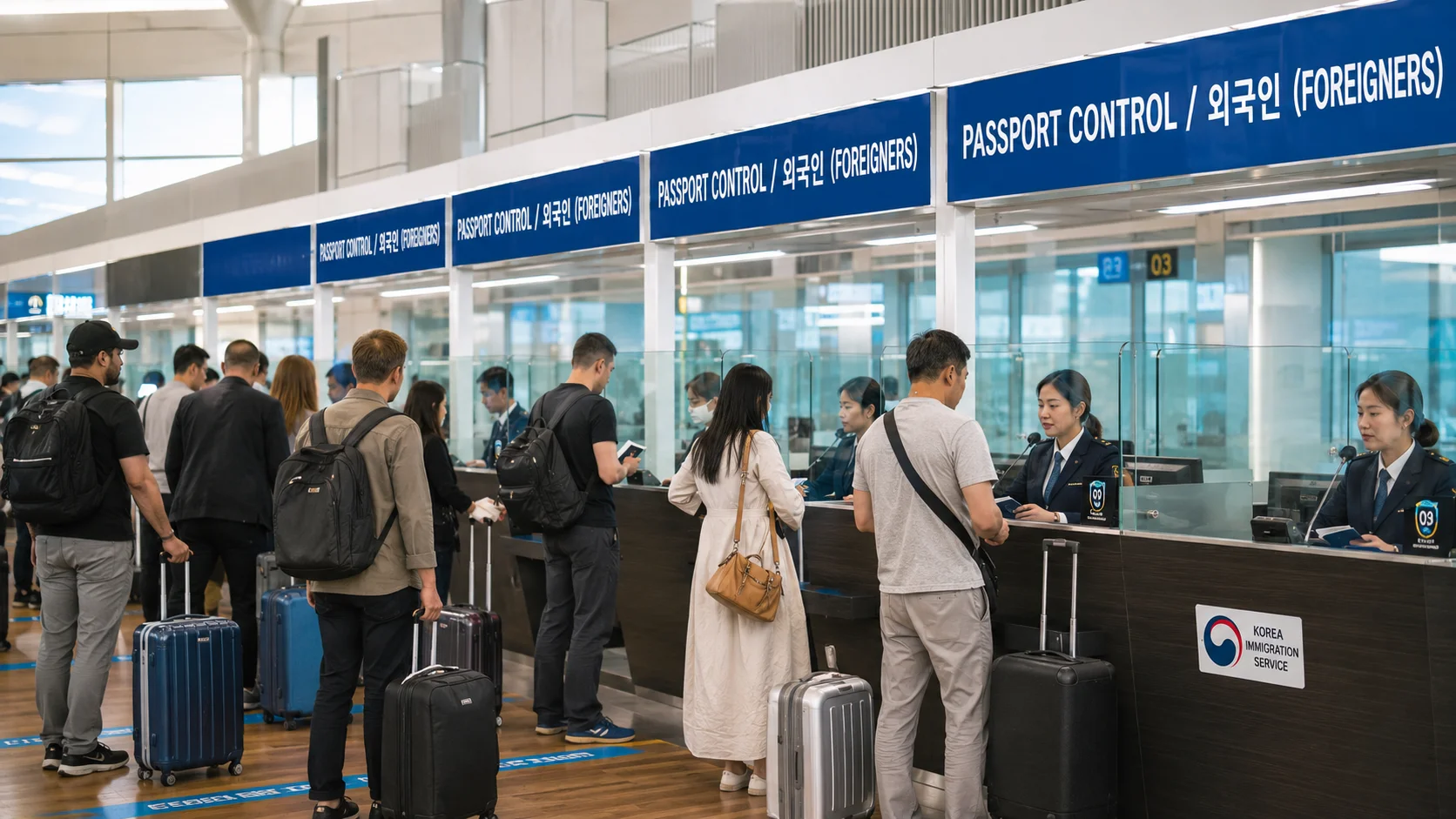
Landing in Korea means passing through four checkpoints, in this order: immigration, an arrival card, customs, and, for some travelers, a health form.
None of it is complicated, but skipping a step, or assuming it works the same way it did on your last trip, can mean a longer line or a customs officer waving you over to the desk.
Walk through each stage below, in the exact order you’ll go through them.
How Does the Immigration Process Work at Korean Airports?
Immigration in Korea works in two stages for most travelers: biometric registration, then an entry stamp. Every foreign traveler aged 17 or older generally goes through biometric screening: two index fingerprints and a facial photo, taken right at the counter.
A few categories are exempt: foreign government officials and representatives of international organizations (along with their family members), and visitors arriving with an official invitation from Korea’s central government. For everyone else, it’s worth expecting this step rather than being caught off guard by an officer asking for your hand.
Traveling with children under 17? They generally aren’t required to go through the same fingerprint and photo process, but they still go through the immigration counter together with a parent or guardian, and the officer still checks their passport and documents.
Most first-time visitors go through a manned counter. Look for signage separating “Foreign Nationals” from returning citizens, since lining up in the wrong lane just means getting redirected. The process itself is short and predictable:
- Join the line marked for foreign nationals (separate from the citizens’ line).
- Hand over your passport along with your arrival documents.
- Place both index fingers on the scanner and look at the camera for your facial photo.
- Receive your passport back with an entry stamp, and you’re through.
If you register for the Smart Entry Service (SES), your future trips get noticeably faster.
SES registration isn’t something you set up online in advance. You register once, in person, at the SES enrollment desk inside the immigration area (separate from the manned passport-control counter) the first time you go through immigration, and that first registration still involves the same fingerprint and facial checks.
From your next arrival on, you can skip the manned counter and use the self-service SES gates instead: scan your passport, walk through the gate, and the same fingerprint and facial checks happen automatically rather than with an officer standing in front of you. The SES gates are generally faster during busy hours, since you’re not waiting behind everyone else in the manned-counter line.
If you’re a foreign resident with an Alien Registration Card rather than a one-time visitor, the registration path is a little different, see our SES eligibility guide for foreign residents for the age, ARC, and reciprocal-program details that apply to you.
Either route ends the same way: an entry stamp (or its digital equivalent) in your passport, which marks the official start of your stay and the date your visa-free period or visa validity begins counting from.
How long this takes depends heavily on your arrival time rather than which airport you land at. A mid-morning arrival at Incheon during a wave of long-haul landings can mean a genuinely long wait at the manned counters, while an off-peak arrival can take just a few minutes.
If your layover or connection is tight, it’s worth building in extra buffer time for immigration specifically, since it’s usually the slowest single step in the whole arrival process, slower than baggage claim or customs for most travelers.
Do You Need to Fill Out an Arrival Card for Korea?
Most travelers do need to submit an Arrival Card, but there are exceptions worth checking before you assume you need one. You’re exempt if you hold a Korean residence card, an approved K-ETA, or an e-Group visa. In those cases, this step is already covered by your existing documentation, and you can skip straight to baggage claim and customs after immigration.
Everyone else needs to submit an Arrival Card, and the easiest way to do it is online before you even board your flight, rather than filling out a paper form during the flight or scrambling at the airport.
Skip the paper form
You can submit Korea’s e-Arrival Card online starting 3 days before your arrival (Korea Standard Time), through the official government portal. Fill it out from your phone in advance, and there’s no paper card to deal with when you land. Just have your passport ready at the counter, since the officer pulls up your submission electronically. Submission is free; any site asking for a payment to file it is not the official portal.

Whether the old paper arrival card is still accepted as a backup varies depending on the source you check. Some reports describe it as fully phased out since January 2026, while others note the ministry responsible for the system has said both formats remain in parallel use until an official end date is announced.
Rather than relying on either version being true at the airport, the safer approach is simple: treat the e-Arrival Card as the default and submit it online before you fly, and don’t count on a paper form being available as a fallback.
Keep these two apart in your head. The Arrival Card and your visa or K-ETA do different jobs.
K-ETA and visas decide whether you may enter Korea at all. The Arrival Card is the paperwork you fill in once you already have that permission.
A valid K-ETA doesn’t automatically waive the Arrival Card either. Whether it’s required turns on your specific visa or entry type, so check the exemption list above rather than assuming.
How Does Customs Declaration Work in Korea?
Whether you need to fill out a customs declaration form depends entirely on what you’re carrying. If you have nothing to declare, you don’t need any paperwork at all. Since May 2023, travelers with nothing to declare can walk straight through the green “Nothing to Declare” line without stopping to fill out a form first, which is a meaningful change from how it used to work.
If you do have goods to declare, one form covers your entire family traveling together, so you don’t need a separate form per person, which saves time if you’re traveling with kids or a partner.
Travelers arriving at Incheon Terminal 2 or Gimpo International Airport can also submit their customs declaration through an app or website ahead of time, rather than filling out a form on arrival, similar to how the e-Arrival Card works. Submitting early doesn’t change what you owe or whether you need to declare. It just moves the paperwork earlier, so you’re not filling out a form while juggling luggage after a long flight.
Practically, this means the customs step looks different depending on what’s in your bags. Travelers with only personal items and everyday purchases under the limits usually spend more time at baggage claim than at customs. Travelers bringing back higher-value electronics, multiple bottles of alcohol, or gifts that push them over $800 in total value are the ones who actually need the red line and a few extra minutes with an officer.
So what actually needs to be declared? It comes down to Korea’s duty-free allowance. Anything within these limits doesn’t need to be reported at all:
| Item | Duty-free limit |
|---|---|
| Total value of goods | US $800 |
| Alcohol | Up to 2 bottles, 2 L combined, value up to $400 (20+ only) |
| Cigarettes | 200 cigarettes / 1 carton (20+ only) |
| Perfume | Up to 100 mL |
Travelers aged 19 and younger don’t get the alcohol or tobacco allowance at all, regardless of how far under the overall $800 limit they are. The alcohol and tobacco allowance simply doesn’t apply at that age or younger, so bringing duty-free alcohol back for a younger family member doesn’t work the way some travelers expect.
There’s a separate currency rule, and it catches travelers off guard. Carrying cash, traveler’s checks or other monetary instruments totaling more than US $10,000, in any currency combined, means declaring it to customs on arrival.
The limit is per person, not per family. You and a companion each carrying $8,000? Neither of you declares. One of you carrying $12,000 alone? That person does.
Carrying cash close to the $10,000 declaration threshold? Our currency exchange and payment guide covers exchange, ATMs, and prepaid card options so you don’t need to carry as much cash.
Going over the limit? Declare it.
Carrying more than the duty-free allowance on goods isn’t a problem by itself: not declaring it is. If you’re over the limit on anything, use the red “Goods to Declare” line instead of the green one. Voluntarily declaring generally comes with a partial reduction on the duty you owe, while getting caught after claiming “nothing to declare” typically costs more, and can involve additional scrutiny beyond just the duty itself. The same logic applies to undeclared cash over the $10,000 threshold: declaring it yourself is a formality, while having it discovered undeclared is treated far more seriously.
Check the current rate
Exact reduction rates and duty calculations can change over time, so for the current figures, check Korea Customs Service’s official English-language site directly rather than relying on older blog posts: customs.go.kr/english.
Watch for fake “customs” calls
Real Korean customs or immigration officers will never call you after you’ve already arrived and left the airport demanding payment by phone, gift card, or wire transfer for unpaid duties. If you receive a call like this, it’s a scam, not a real enforcement action. Hang up, and don’t share any card or account information.
What Is Q-Code and Who Needs It Before Entering Korea?
Q-Code only applies to a specific group of travelers: those arriving from regions Korea has officially designated as quarantine-management areas at the time of travel. If that doesn’t describe your trip, you can skip this step entirely. Most visitors never touch Q-Code at all.
If it does apply to you, the system works as pre-registration rather than something you fill out on the spot. You can register your health status online in advance of your arrival, answering questions about your travel history and health condition ahead of time instead of at the airport.
Completing Q-Code registration in advance means you won’t need to fill out the in-person Health Questionnaire at the airport. Q-Code registration replaces that step rather than adding an extra one on top of it, so registering early genuinely saves you time on arrival rather than being just an extra formality.
Because which regions are designated can change, it’s worth checking your specific departure point close to your travel date rather than assuming last trip’s status still applies, especially if your itinerary includes a layover in a region with different quarantine rules than your final departure point.
The purpose is straightforward. Q-Code lets Korea’s quarantine authorities screen for infectious disease risk from specific regions without putting every arriving traveler through the same questionnaire.
For most visitors, arriving from destinations with no active quarantine designation, the step simply doesn’t apply. You go from immigration straight to baggage claim and customs, with no detour through health screening.
Useful Official Websites
Clearing Up Immigration & Customs Questions
No. You’re exempt if you hold a Korean residence card, an approved K-ETA, or an e-Group visa. Everyone else submits the e-Arrival Card, ideally online before arrival rather than on paper during the flight.
No. Since May 2023, travelers with nothing to declare can go straight through the green “Nothing to Declare” line without filling out any paperwork.
US $800 total, including up to 2 bottles (2 L, $400 value) of alcohol and 200 cigarettes, but only for travelers 20 and older. Travelers aged 19 and younger don’t get the alcohol or tobacco allowance at all.
Declaring it voluntarily at customs usually gets you a partial reduction on the duty owed. Getting caught after claiming “nothing to declare” typically costs more than declaring it upfront.
Only travelers arriving from regions Korea has designated as quarantine-management areas. Registering in advance replaces the in-person Health Questionnaire, rather than adding an extra step.
Generally yes, for travelers 17 and older, including at the automated Smart Entry Service gates, which check the same information by machine rather than skipping it. A few categories are exempt: foreign government officials and representatives of international organizations (and their family members), and visitors arriving with an official invitation from Korea’s central government.
Only if it totals more than US $10,000 (or the equivalent in any currency, combined across cash and other monetary instruments), and only per person rather than per family. Amounts below that don’t need to be declared.
Reports differ on this. Some describe the paper card as fully phased out since January 2026, while others say both formats remain in parallel use until an official end date is announced. The safest approach is to submit the e-Arrival Card online before you fly rather than counting on a paper form being available at the airport.
Not sure which visa or K-ETA you need before you even get to this stage? Check our Visa & K-ETA guide first.
Carrying something you’re not sure is allowed, or traveling with a pet? See our Prohibited & Restricted Items guide and our Animal & Plant Quarantine guide.
Still have questions? Contact the Foreigners’ General Information Center at 1345 (Weekdays 09:00-22:00).
We hope your arrival in Korea goes smoothly. Safe travels!



Comments
Leave a comment