
- What Currency Does Korea Use, and Where Can You Exchange Money?
- Where Do You Get the Best Exchange Rate?
- Should You Bring Cash or Rely on Your Card in Korea?
- Do Foreign Credit and Debit Cards Work at Korean Stores?
- How Do You Withdraw Won From an ATM in Korea?
- What Is WOWPASS, and Is a Prepaid Travel Card Worth It?
- Cash vs Card vs Prepaid Card: Quick Comparison
- Need Help?
- Still Have Questions About Money in Korea?
Not sure whether to exchange cash before you land or just tap your card everywhere?
Wondering if a prepaid travel card like WOWPASS actually saves you money?
Here’s a practical breakdown of how money works in Korea, from exchange counters to ATMs.
What Currency Does Korea Use, and Where Can You Exchange Money?
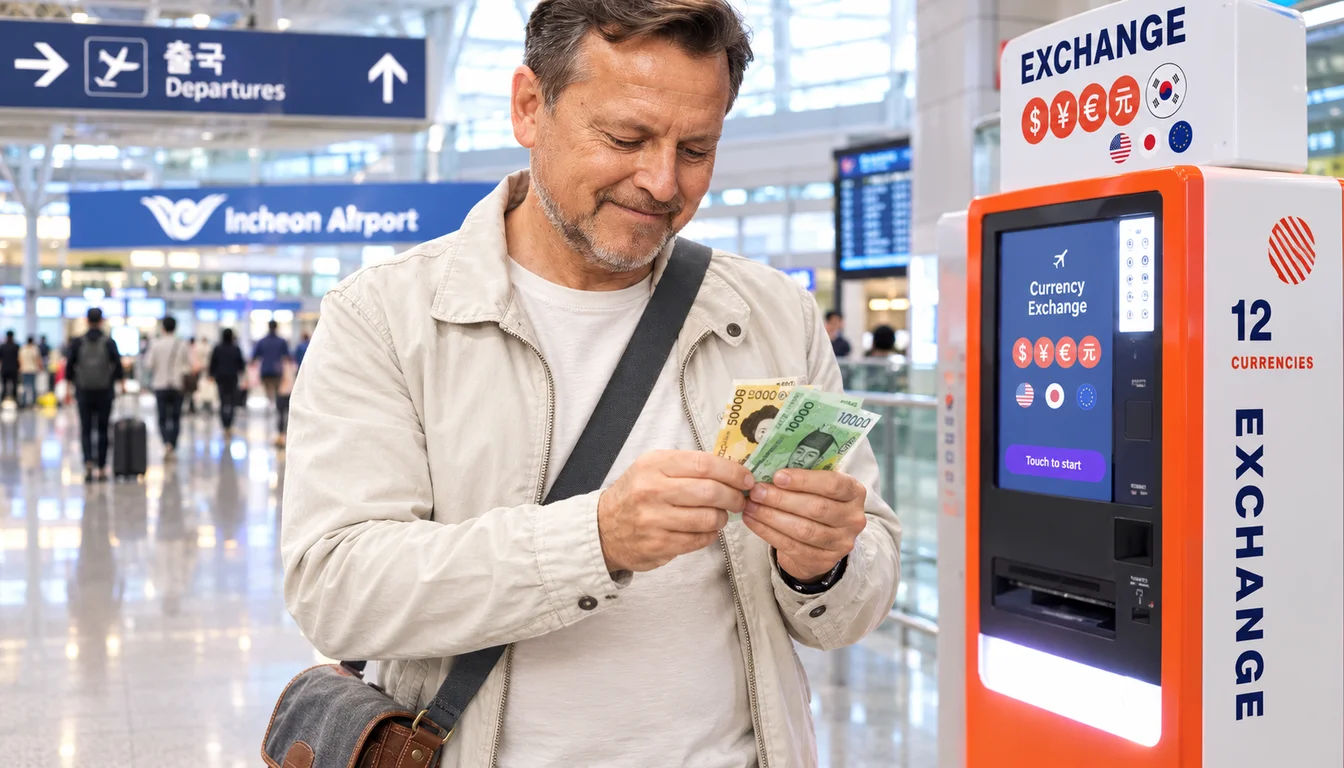
Korea’s official currency is the won (₩). Banks, post offices and licensed money-changers across the country will all exchange foreign cash for it.
Banks run 09:00-16:00 on weekdays, give or take by branch. Korea Post Bank branches stay open a bit later, until around 16:30. Outside those hours, licensed exchange counters in tourist areas and at the airport fill the gap, though rates and fees differ from bank to bank.
Korean won comes in four bills: 50,000, 10,000, 5,000 and 1,000 won. Then four coins: 500, 100, 50 and 10.
Exchange a small amount before you go all-in on cards. Coins and small bills earn their keep at lockers, vending machines, and traditional-market stalls that don’t take cards.
Old or damaged bills may be refused.
Some exchange counters won’t accept older currency designs or visibly worn bills from your home country. If you’re exchanging cash you’ve had sitting around for a while, check with the counter beforehand or bring newer notes if possible.
Where Do You Get the Best Exchange Rate?
City-center exchange counters and banks usually beat airport kiosks on rate. Airport kiosks price in convenience and high rent.
So if your schedule allows, change just enough at the airport for your first taxi or subway ride. Do the larger exchange later, at a bank or licensed money-changer in the city. That’s the standard way to keep airport-rate markups off your full trip budget.
- Banks: Reliable and regulated, but hours are limited to weekday banking hours and the process can take longer than a private counter
- Airport exchange counters: Convenient and open extended hours, but rates are usually the least favorable of the three options
- Licensed city exchange counters: Common in tourist districts, often with competitive rates and no or low commission, so always check that the counter is licensed before handing over cash
Compare rates before you exchange.
Check the live reference rate on a currency converter such as xe.com before exchanging, so you can quickly tell whether a counter’s posted rate (and any commission) is reasonable.
Should You Bring Cash or Rely on Your Card in Korea?
You’ll want both. Korea is card-friendly, but a modest amount of cash smooths out the rough edges.
Cards handle almost all everyday spending: restaurants, cafés, convenience stores, department stores, transit. Cash covers the handful of situations where a card isn’t accepted or isn’t practical.
Keep a small amount of won on hand for:
- Small traditional-market stalls and some street food vendors that are cash-only
- Coin lockers at stations and tourist sites
- Very small, independently run shops in rural or less touristy areas
- Temple donation boxes and similar situations where card payment isn’t set up
Everything else, including most taxis, convenience stores, and virtually all restaurants and cafés in cities, takes cards without issue, so there’s no need to carry large amounts of cash for a typical trip.
Do Foreign Credit and Debit Cards Work at Korean Stores?
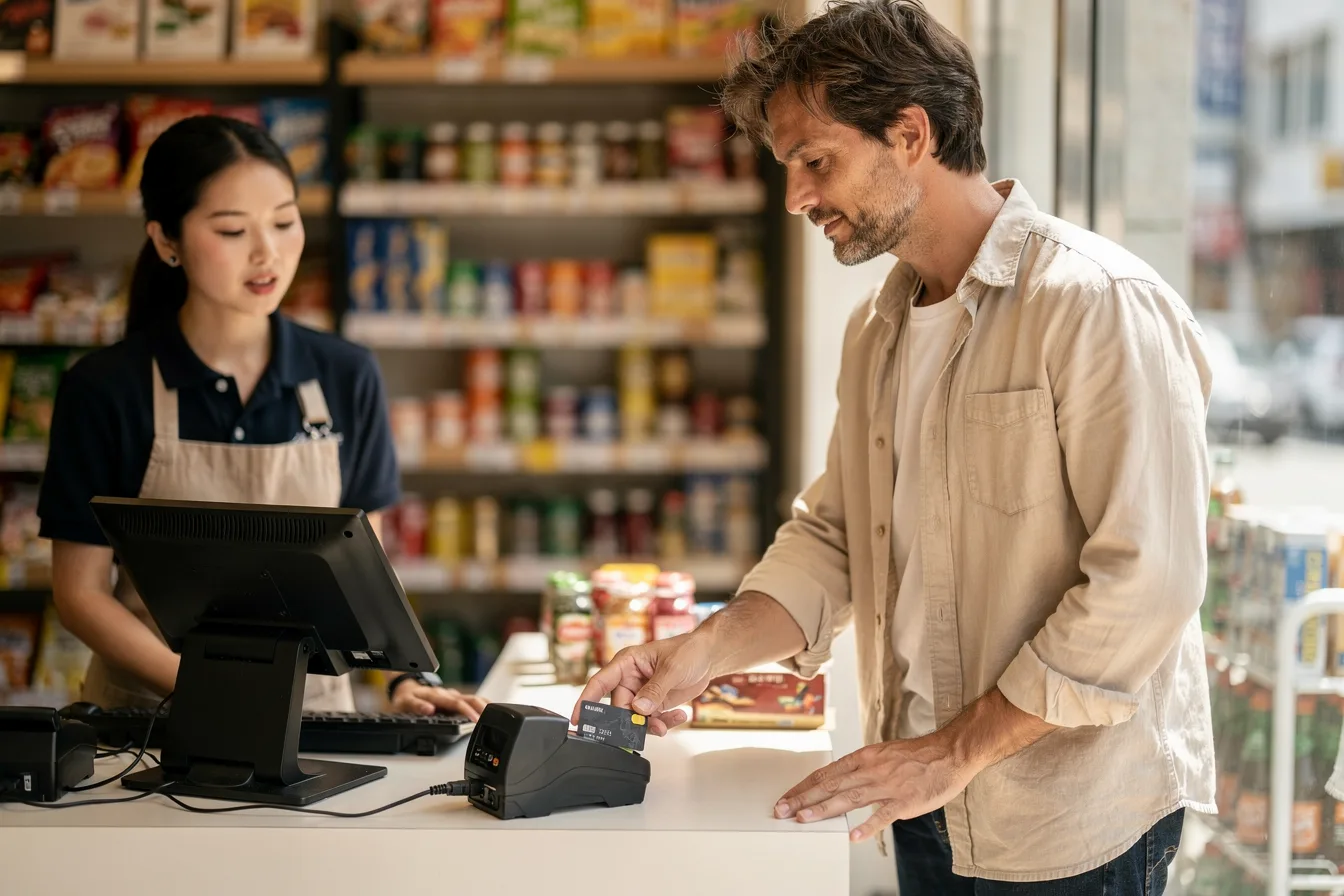
Yes. Most businesses in Korea widely accept credit cards, including major hotels, department stores, and general shops, and Visa, MasterCard, and American Express are all commonly accepted.
Acceptance does vary by merchant, so it’s worth having more than one card network in your wallet as a backup, particularly if you’re carrying an American Express card, which sees somewhat narrower acceptance than Visa or MasterCard outside major hotels and malls.
A few practical things to check with your card issuer before you fly:
- Whether your card charges a foreign transaction fee on purchases made in Korea
- Whether your card supports contactless (tap-to-pay): most modern Korean card terminals support it, and it’s the fastest way to pay
- Setting a travel notification so your bank doesn’t flag Korea purchases as suspicious and block your card
Some very small vendors and older terminals are card-shy.
A handful of small shops, market stalls, and older payment terminals may only accept domestic Korean-issued cards or may have a minimum purchase amount for card payments. If a card is declined somewhere small, it’s often not a problem with your card. Just switch to cash.
How Do You Withdraw Won From an ATM in Korea?
You can pull won straight from your home bank card. Look for ATMs carrying your card network’s logo: Visa Plus, Mastercard Cirrus, Maestro, or the Global and international symbols.
These machines are everywhere. Airports, major bank branches, and inside many convenience stores. Look for ATMs labeled “Global” or with an English-language option: these are set up specifically for foreign-issued cards and usually offer clearer instructions in English than a standard domestic-only machine.
- Airports: Incheon and other international airports have global ATMs in the arrivals area, making them a convenient first stop for cash
- Convenience stores: Chains like GS25, CU, and 7-Eleven often have ATMs that accept foreign cards, and they’re open around the clock
- Bank branches: Major banks with international-friendly ATM networks are widely available in cities and near tourist areas
Expect two sets of fees.
An ATM withdrawal in Korea usually involves a local ATM operator fee (charged by the Korean bank or convenience store) plus whatever foreign transaction or withdrawal fee your home bank applies. Check your bank’s foreign ATM fee policy before you travel, and consider withdrawing larger amounts less often to reduce how many times you pay the flat local fee.
What Is WOWPASS, and Is a Prepaid Travel Card Worth It?
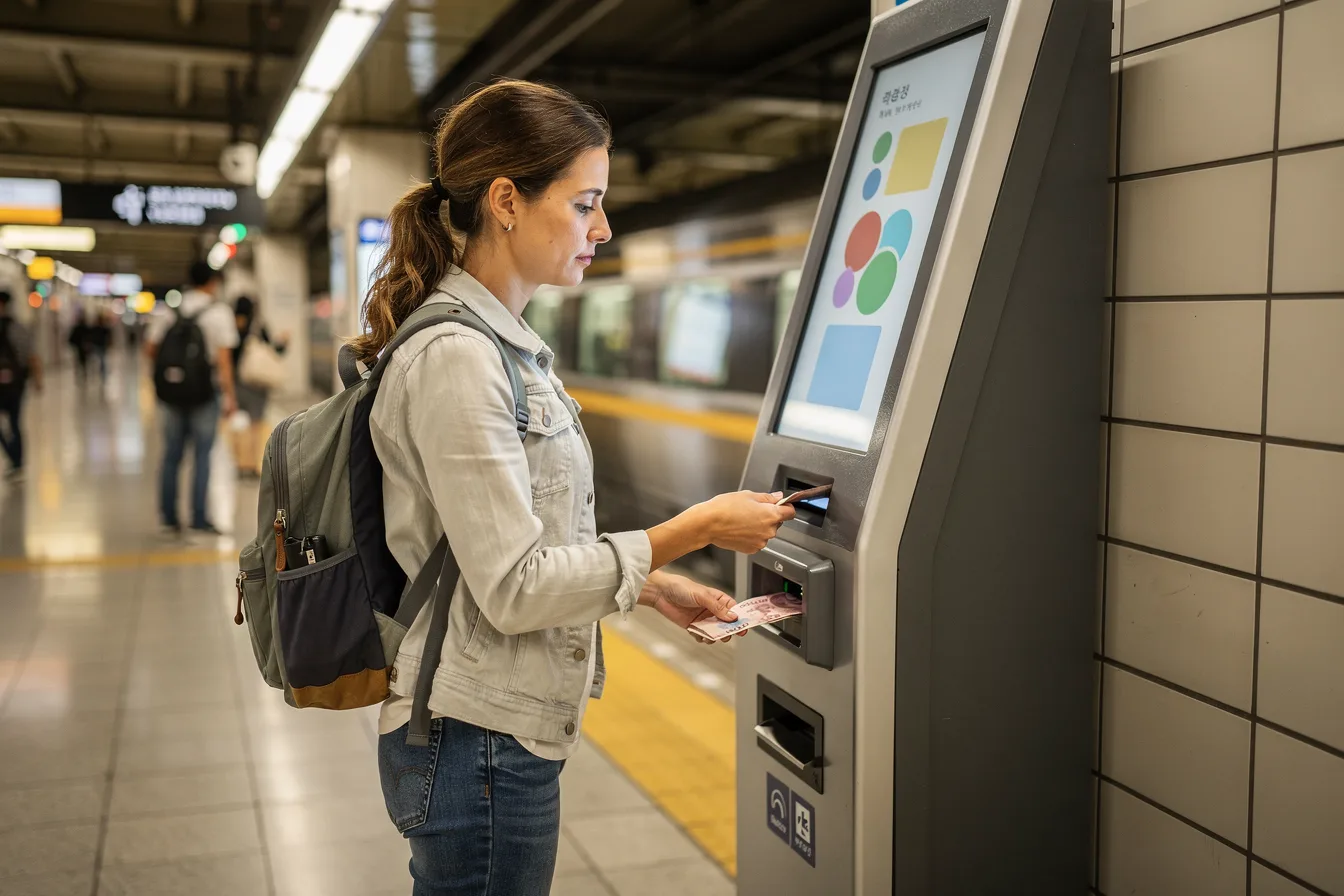
WOWPASS is a prepaid travel card built around self-service kiosks. You’ll find them at the airport, in subway stations, and in tourist districts like Myeongdong and Hongdae.
At the kiosk you exchange foreign cash, or load from a card, straight onto a WOWPASS card. That card then works as a general prepaid payment card at stores and as a rechargeable transit card for buses and the subway, which is useful if you’d rather not juggle a separate T-money card and cash wallet.
The appeal is convenience: one card handles transit fares and everyday purchases, the kiosk interface supports English and other languages, and you avoid repeated bank-counter visits.
The trade-off is the same as with any prepaid card. You exchange money upfront, at whatever rate the kiosk is showing that moment.
Leftover balance has to be spent down or refunded at the end. Refund processes and fees vary, so check the current terms in the app or at the kiosk before you commit a large amount.
- Good fit if: you want one card for transit + purchases and prefer not to carry much loose cash
- Less useful if: your own debit/credit card already has low foreign fees and wide acceptance, since in that case a prepaid card mostly adds an extra step
Check the app before you land.
WOWPASS (and similar prepaid travel cards) usually have an official app where you can preview kiosk locations and current terms. It’s worth a quick look before your trip so you’re not deciding on the spot at an airport kiosk. See our guide to must-have travel apps in Korea for WOWPASS and the other apps worth downloading before you land.
Cash vs Card vs Prepaid Card: Quick Comparison
Use this table to quickly match a payment method to your travel style.
| Method | Best for | Watch out for |
|---|---|---|
| Cash (won) | Markets, coin lockers, small cash-only vendors | Exchange rate/commission varies by location |
| Foreign credit/debit card | Restaurants, cafes, malls, most transit and taxis | Foreign transaction fees, occasional small-vendor limits |
| ATM withdrawal | Topping up cash as needed, no need to pre-exchange | Local ATM fee + your bank’s foreign withdrawal fee |
| Prepaid card (e.g., WOWPASS) | Combining transit + purchases on one card | Upfront exchange rate, unused balance refund process |
Need Help?
Before your trip, it also helps to have your entry paperwork sorted. See our Visa & K-ETA guide for what you need before you fly.
And if you’re carrying a large amount of cash, note that amounts equivalent to $10,000 USD or more must be declared to customs on arrival. Our Immigration and Customs guide covers the declaration process in full.
If you’re still working out how much to budget overall, our Korea travel budget guide breaks down typical daily costs by travel style.
Foreigners’ General Information Center 1345
- Phone Number: 1345 (Domestic) / +82-1345 (International)
- Hours: Weekdays 09:00-22:00
- 09:00-18:00: Supported in 20 languages including Korean, English, Chinese, Japanese, Vietnamese, Thai, and Mongolian
- 18:00-22:00: Korean, English, Chinese
Useful Resources
Still Have Questions About Money in Korea?
You don’t need to exchange a large amount in advance. It’s common to exchange a small amount at the airport just to cover your first taxi or transit ride, then exchange more later at a bank or a licensed city exchange counter, which usually offer better rates than the airport.
Card, for most of your spending. Korea is very card-friendly and most restaurants, cafes, shops, and transit accept cards without issue. Keep a modest amount of cash on hand for traditional markets, coin lockers, and small cash-only vendors.
Visa and Mastercard are widely accepted at hotels, department stores, and general shops. American Express is accepted too, but its acceptance is somewhat narrower outside major hotels and malls, so it’s worth carrying a Visa or Mastercard as a backup.
Yes, as long as the ATM displays your card network’s logo (such as Visa Plus, Cirrus, or Maestro). Airports, convenience stores like GS25 and CU, and major bank branches are reliable places to find ATMs that accept foreign cards, often labeled “Global” or with an English-language option.
Typically two: a local ATM operator fee charged by the Korean bank or convenience store, plus any foreign transaction or withdrawal fee your home bank applies. Check your bank’s policy before you travel, and consider withdrawing larger amounts less frequently to minimize flat local fees.
WOWPASS is a prepaid travel card you load via self-service kiosks at the airport, subway stations, and tourist areas, and it works for both transit fares and everyday purchases. It’s convenient if you want one card for everything, but it’s optional: if your own card already has low foreign fees and wide acceptance, a prepaid card mainly adds convenience rather than savings.
Amounts equivalent to $10,000 USD or more (cash and cash-equivalents combined) must be declared to Korean customs on arrival. See our Immigration and Customs guide for the full declaration process.
Yes, most modern card terminals in cities support contactless payment, and it’s generally the fastest way to pay. Some older terminals at very small vendors may still require chip-and-PIN or may not accept foreign-issued cards at all. Cash is a reliable backup in those cases.
Carry a little cash, keep one card that works abroad, and you’re covered for almost everything Korea will throw at you.
For anything this guide didn’t answer, the Foreigners’ General Information Center takes calls on 1345, weekdays 09:00-22:00.



Comments
Leave a comment